Australia is home to six native citrus species, all of which are still relatively obscure compared to the globally recognised Tahitian and Persian limes. We’ve wanted to talk about Australian limes for a while now, and with citrus season well underway, this seemed like the perfect time to celebrate our weird and wonderful native varieties.

Mindy Woods
Tucker Bush Culinary Director
“In Indigenous cultures, foods like citrus fruits aren’t simply ingredients. They’re part of a living ecosystem that sustains people for countless generations.
They grow amongst towering trees and ferns, amidst desert scrub and forest savannahs, surrounded by the many other foods, medicines and materials the natural world provides.
Knowing when these fruits were ready to harvest, where they grew best, and how to care for the Country they came from was knowledge passed down through generations.”
Meet the six native Australian citrus fruits

Australian Finger Lime (Citrus australasica)
Currently a flourishing favourite in the fine dining scene, Australian Finger Lime is prized for its caviar-like pulp and range of fruit colours. This native citrus were first found in the sub-tropical regions in the Bundjalung nation, spanning Northern New South Wales and southern Queensland.
Finger Lime fruits late in the year, typically from August to October, producing stubby finger-shaped goodies filled with sweet and tangy citrus pearls. They’re a great match for sweet and savoury dishes, with both juice and pulp the ideal complement to seafood dishes. Try these Wattleseed profiteroles with Finger Lime cream!

Dooja (Citrus australis)
Dooja are also known as Gympie Lime or Round Lime, aptly named for their round, golf ball–sized fruits covered with knobbly green skin. A lowland-forest native growing from Beenleigh to Gympie in Queensland, this species has been the subject of study for its disease-resistant properties and superfood potential.
As a slow grower, Dooja is suitable for container gardening, and makes an excellent ornamental plant or edible hedge if you don’t mind its thorny branches. Regular fertilising with the right nutrients can encourage this plant to fruit more readily.
Desert Lime (Citrus glauca)
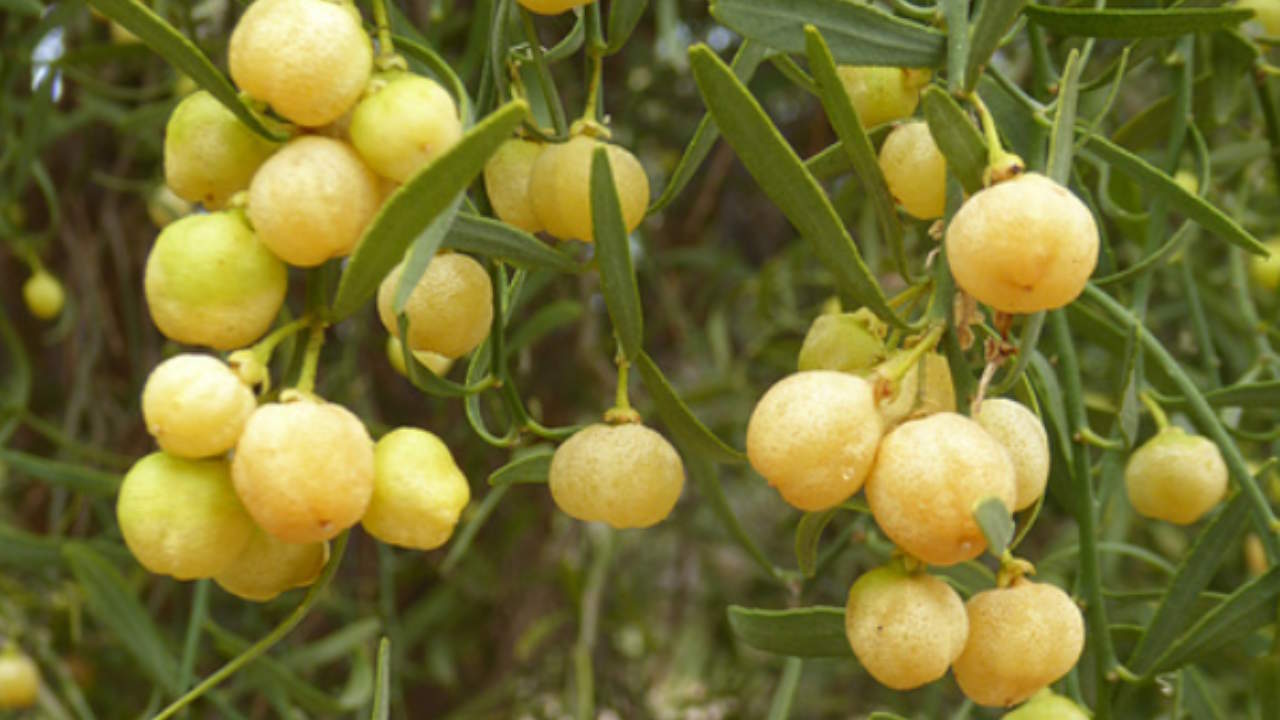
A small fruit that’s big on flavour: native to the inland regions of Queensland, New South Wales, and South Australia, the Desert Lime (aka. wild lime, desert kumquat) produces grape-sized fruits in green-yellow clusters. Eat them whole, the way they were traditionally enjoyed, or turn them into jams, pickles, candied peel and cocktails.
While some citrus species double up as a seasonal ornamental, you’re better off planting the Desert Lime for fruit. Fast fruit set is a special feature of this species, a way to survive the harsh desert climate. If you live along the coast or in a wetter climate, look for grafted cultivars that do better in moist conditions.
Mount White Lime (Citrus garrawayi)
Mount White Lime is a thornless understorey plant native to the tropical rainforests of North Queensland’s Cape York region, producing fruits that look similar to Finger Lime. This species is considered rare in the wild, and is not commercially grown for food, but you can find it grown under cultivation and available at some nurseries.
Humpty Doo Lime (Citrus gracilis)
Humpty Doo Lime, also known as Kakadu Lime, is a straggly tree with knobbly, wrinkled, somewhat pear-shaped fruits and thick, corky bark. A Northern Territory native, this uncommon species is endemic to eucalypt woodlands.
Russell River Lime (Citrus inodora)
Russell River Lime, aka. large leaf Australian wild lime, is native to the Wooroonooran/Bellenden Ker mountain range in Far North Queensland. Its fruits ripen to a yellowish-green, with mixed reports on the intensity of flavour. However, studies have shown that this species has up to four times the vitamin C content of the more widely known Tahitian lime. Russell River Lime is an endangered tropical citrus species and a known host to the Ambrax butterfly.
References
- MacGregor, N. (2026, February 5). Unlocking the sublime in native Australian citrus. Retrieved March 16, 2026, from https://hortjournal.com.au/2026/02/unlocking-the-sublime-in-native-australian-citrus/
- Halter, A., & Nichols, J. (2023, May 30). Researchers say native Gympie limes could help fight citrus greening disease killing crops. ABC News. Retrieved March 16, 2026, from https://www.abc.net.au/news/rural/2023-05-30/gympie-native-lime-fighting-citrus-disease/102386570
- Koskinen, J., & Jousse, S. (2016, April 27). Native Australian and New Guinean citrus. Citrus Pages. Retrieved March 16, 2026, from http://citruspages.free.fr/australian.php#garrowayi
- Citrus garrawayi. (2023, June 27). In Wikipedia. https://en.wikipedia.org/wiki/Citrus_garrawayi
- Citrus gracilis. (2023, December 10). In Wikipedia. https://en.wikipedia.org/wiki/Citrus_gracilis
- (n.d.). Citrus gracilis (multiple pages). Home Citrus Growers. Retrieved March 16, 2026, from https://www.homecitrusgrowers.co.uk/australiannativecitrus/citrusgracilis1.html
- (n.d.). Australia 2016 …. Finding Citrus inodora. Home Citrus Growers. Retrieved March 16, 2026, from https://www.homecitrusgrowers.co.uk/australia2016/australia2016inodora.html
- Citrus inodora. (2026, January 6). In Wikipedia. https://en.wikipedia.org/wiki/Citrus_inodora